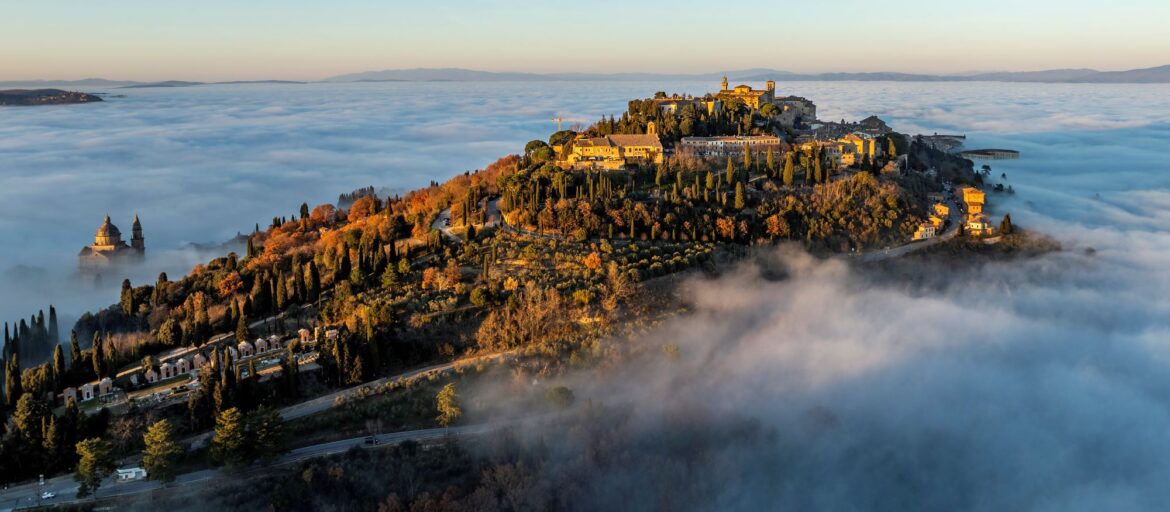
Montepulciano: Porsenna’s head on display at the Civic Museum
Montepulciano rediscovers the face of its legendary founder. After five centuries, the sculpture of the Head of Porsenna, a fragment of a work created by Andrea Sansovino in the early 16th century to celebrate the origins of Montepulciano, is once again on public display. The new storage facility at the Crociani Civic Museum and Art Gallery is part of the “Etruscan Project 1985 – 2025,” promoted by the Tuscany Region together with the Fondazione Musei Senesi and AMAT (Associazione Musei Archeologici Toscana), which includes exhibitions and events showcasing the museum’s Etruscan heritage.
In this context, the Crociani Civic Museum and Art Gallery, in collaboration with the Fondazione Musei Senesi, had the honor of presenting on Thursday, July 10, a work of inestimable importance to the history and identity of Montepulciano in the exhibition entitled “Porsenna between History and Legend.” To celebrate this addition to the city’s heritage, the Municipality has granted free admission to the Museum to all residents from Thursday, July 10th, until Sunday, July 13th.
The Head of King Porsenna is part of a work that symbolizes the rediscovery of the Etruscans as the ancestors of the Medici lineage, who, by virtue of this lineage, felt legitimized to dominate the Tuscan territory. In 1641, Spinello Benci, secretary to Prince Giovan Carlo de’ Medici, wrote in his History of the City of Montepulciano that King Porsenna—a powerful Etruscan ruler of the 5th century BC—fleeing the now-destroyed Chiusi, settled on “mons Mercurii,” where the city was born, renamed Mons Politicus, or Montepulciano.
Of uncertain commission, the statue was originally about three meters tall, a “colossus” in painted terracotta imitating bronze, of which Giorgio Vasari wrote, “And [Andrea] made a large clay figure for Montepulciano, that is, a King Porsenna, which was a singular thing…” (The Lives, 1568). A few years after these lines were written, the statue was destroyed, and even its head was lost until 1836. Today, thanks to the owners’ willingness, between history and legend, the time has come for King Porsenna to return to his hometown of Montepulciano.
The initiative is part of Valdichiana2025, Tuscan Capital of Culture.